The risks of torture and other ill-treatment in prisons are not always easy to spot. They can be found in everyday routines, conditions and practices – long before they result in serious harm.
DIGNITY’s new manual helps prison monitors identify those risks and act on them.
Medical Director Marie Brasholt answers seven questions about what to look for, how to monitor safely and how findings can lead to change.
Seven questions for Marie Brasholt
01
DIGNITY has just developed a new manual on prison monitoring. Why was a new manual needed?
Our manual is unique in that it tries to combine several aspects of monitoring: Understanding prisons, international human rights and other standards, how to conduct prison visits in ways that enable monitors to discover what may not be obvious at first sight, and how the work of monitoring bodies goes beyond the actual visits and also covers how to engage constructively with authorities to maximize the chance of long-term impact and improvement.
02
The new manual is about preventive monitoring. Can you explain what that is?
We use the term preventive monitoring to underline the overall purpose of this type of monitoring, namely to identify problems and their underlying causes, also called root causes. The overall aim is to give recommendations that will eventually help prevent torture and ill-treatment from happening in the first place. This type of monitoring is different from discussing and finding solutions in individual cases that monitors may encounter and that should be dealt with by others, for example existing complaints mechanisms. In other words, preventive monitoring is not reactive but looks ahead and tries to resolve the structural and other issues leading to an increased risk of torture and ill-treatment in an institution.
03
When you walk into a prison as a monitor, what do you look for?
A prison visit is not simply a tour of the premises. More importantly, a monitor will speak with staff and people in detention to hear about their experiences. They will also look at relevant documents, for example house rules, registers and medical records. Based on these three ways of collecting information, observation, interviewing and analyzing documentation, the monitors can compare what they hear and see from different sources and draw their own conclusions.
The monitors will look into different topics depending on the context and sometimes also their previous knowledge about the institution. Some examples of topics include the use of force, relations between staff and people in prison and among people in prison, including violence, work and activities as well as time outside the cell, visits and contact with the outside world.
04
A prison can comply with the rules and still have serious problems. How do monitors spot the risks that are less obvious?
Often, the devil is in the detail, and monitors will spot risks and problems by talking with the people in prison as well as staff and asking very detailed questions about the daily life in prison. Sometimes the monitors will pay special attention to persons that are particularly vulnerable in a prison setting, for example foreigners who do not receive visits, or those with a mental health condition that makes them unable to understand and follow the rules. Also, sometimes a monitor will simply ask for doors to be opened that the staff try to guide them past.
05
What can a doctor or other health professional see that other monitors might miss?
A medical doctor on a monitoring team has two important tasks in addition to the general monitoring. The first task is to go into depth into how the prison health services function. There are a lot of aspects that can be assessed there, including but not limited to how persons in prison get access to medical personnel, what happens if someone falls ill at night, whether medication is available, and what roles the health personnel play in relation to the use of force, solitary confinement and hunger strikes.
The second task is to assess persons who claim to have experienced violence or other types of ill-treatment or when another member of the monitoring team suspects that this may have been the case. Usually, the medical doctor will then speak with the person and do a quick examination to assess the situation.
06
Speaking to a monitor can put a person in prison at risk of reprisals. How do you make sure monitoring does not cause harm?
Monitors should take great care to ensure that interviews take place in private with no staff members or other detainees within hearing distance and preferably also not within sight unless this is strictly necessary for security reasons. Sometimes, it can be necessary to interview many persons to hide who provided a particular piece of information. And sometimes, the monitoring team may need to ask the director to ensure the transfer of a certain person in the prison to another ward or even to another institution. Finally, follow-up visits can be conducted, which may act as a deterrent against reprisals.
07
You identify a problem and write a recommendation. What does it take for that to actually change what happens inside a prison?
Good recommendations start with how a monitoring visit is planned and carried out. Monitors need to do their utmost to not only discover what is happening but also to understand why it is happening.
This understanding will help them write recommendations that are specifically targeted at an existing problem. For example, lack of access to healthcare could be caused by security staff filtering requests and not allowing persons in prison to go to the health clinic, it could be overcrowding leading to a huge workload for the health staff, or it could be that the prison ambulance has broken down, preventing the transfer to an outside hospital. The list could go on. The recommendation, of course, needs to take the root cause of the problem into account for it to be actionable in the prison.
Another important element is constructive dialogue. If monitors get too confrontational, they will get less information and may be perceived negatively which will not be conducive to a successful outcome. Finally, recommendations can be given at different levels. For example, a prison director will not be able to change the law, and should such a recommendation be relevant it should be discussed with decision-makers, not those who implement the law.
In Denmark, DIGNITY is part of the National Preventive Mechanism (NPM), which monitors conditions in prisons and other places where people are deprived of their liberty. Additionally, DIGNITY supports local partners around the world in their work to monitor prisons.
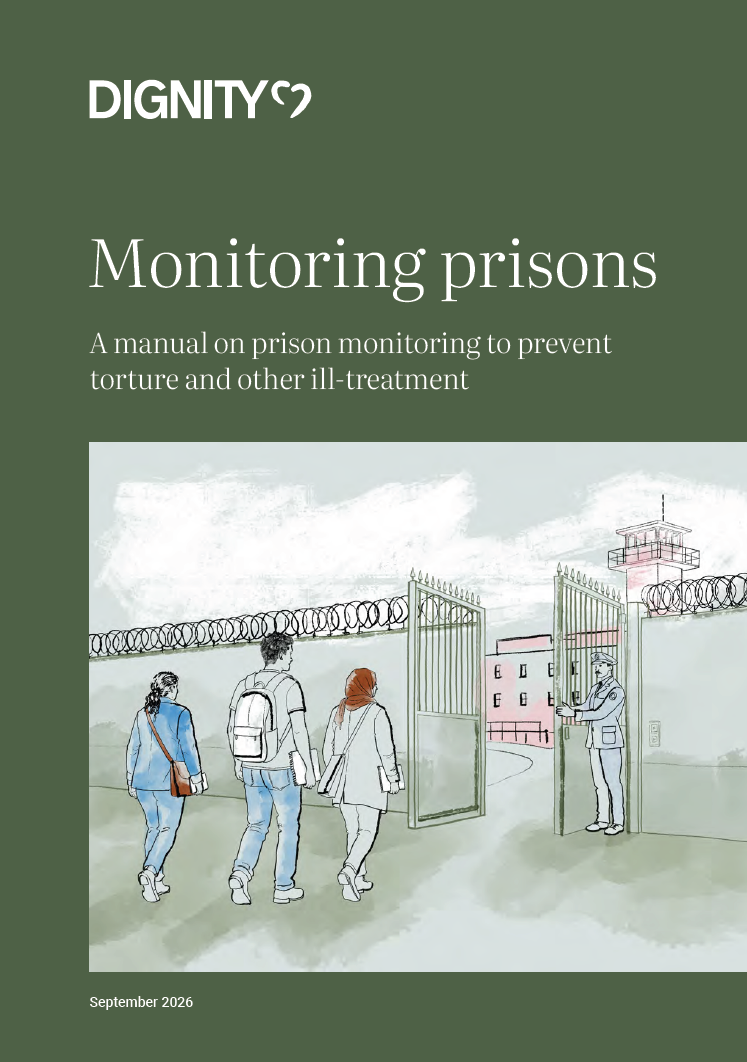
Monitoring prisons
A manual on prison monitoring
to prevent torture and other ill-treatment