
• Report • May 2026 •
Russia Unlawfully Deported
Ukrainian Prisoners
to Its Territory
A new DIGNITY report documents the deportation of approximately 1,700 Ukrainian civilian prisoners from Russian-occupied Ukrainian territory to detention facilities in the Russian Federation — under armed control, in inhumane conditions, and in breach of international humanitarian law.
A new DIGNITY report documents the deportation of approximately 1,700 Ukrainian civilian prisoners from Russian-occupied Ukrainian territory to detention facilities in the Russian Federation — under armed control, in inhumane conditions, and in breach of international humanitarian law.
»If there is any trouble, we will shoot. Sit quietly, and everything will be fine. Otherwise, there will be dead bodies«.
This is how one former Ukrainian prisoner described what soldiers with automatic weapons told prisoners during transport. They were loaded into Russian prison vans or KAMAZ trucks under armed control and transferred via Occupied Crimea and the Russian Federation before being placed in prisons in the Russian Federation.
The report ‘Deportation to Hell’ documents the deportation of approximately 1,700 Ukrainian prisoners— Ukrainian citizens and foreign nationals serving custodial sentences at the time of the Russian Federation’s invasion of Ukraine on 24 February 2022 — from occupied Ukrainian territory to prisons in the Russian Federation in November 2022.
Key findings in the report
1
1700
Approximately 1,700 Ukrainian prisoners were deported from occupied Ukrainian territory to prisons in the Russian Federation in November 2022.
Prisoners were deported without official information and against their will. Interviewees described threats, beatings, overcrowded transport, lack of food, water and toilet access.
Prisoners were repeatedly offered Russian citizenship throughout the deportation process.
300
Around 300 deported prisoners remained held in prisons in the Russian Federation or remained on Russian territory after release without effective means of leaving at the time of the report.
The report finds that the deportation likely constitutes the war crime of unlawful deportation and may also amount to the crime against humanity of deportation.
Throughout the deportation process, prisoners were subjected to physical and psychological ill-treatment and held in inhumane conditions. They described beatings, prolonged stress positions, humiliation, and threats of physical or sexual violence, often because of their nationality and their actual or perceived support for Ukraine.
Prisoners were also forced to abandon personal belongings, including vital medication, and transported in overcrowded vehicles, sometimes alongside prisoners with tuberculosis, without sufficient food, water, sanitation, ventilation or medical care.
The report concludes that this conduct constitutes grave breaches of international humanitarian law likely amounting to war crimes under the Rome Statute of the International Criminal Court. It further indicates that the conduct may also amount to crimes against humanity.
The evidence behind the report
2
The evidence behind the report based on 233 testimonies
Collected from current or former prisoners deprived of their liberty in Ukraine. Collected between 20 November 2022 and 31 December 2024 by Protection of Prisoners of Ukraine.
95% reported ill-treatment
Interviewees reported being subjected to or witnessing ill-treatment during deportation and detention, including beatings, prolonged stress positions, intimidation, humiliation and threats of physical or sexual violence.
All interviewees reported being deprived of contact with their families after deportation to the Russian Federation.
Other Sources
The report also draws on court judgments, medical records, information from Ukrainian state authorities, UN and NGO reports, media articles, social media posts and interactive maps.
Findings assessed under “reasonable grounds to believe”
The reviewed information was corroborated where possible and considered sufficiently credible to indicate that the conduct described likely occurred.
01
Taken without answers
The deportations began on 3 or 4 November 2022 and continued over the following days in several stages. In the weeks or months before, Ukrainian prisoners had been moved from Pivnichna, Dariivska, Snihurivska and other penitentiary facilities in occupied Ukrainian territory to Holoprystanska, which served as the main staging point for the deportation.
From Holoprystanska, they were transferred through transit centres in Occupied Crimea and the Russian Federation before being placed in prisons in Krasnodar Krai, Volgograd Oblast and Rostov Oblast in the Russian Federation. The operation was carried out by Russian occupying forces and authorities, including personnel of the Russian armed forces, various special forces and units, and the Federal Penitentiary Service of Russia (FSIN). Local Ukrainian prison staff also assisted.
For many prisoners, the transfer began without official explanation. Lists were read out. Prisoners were ordered to prepare.
»Nobody told us where we were being taken«.
FORMER UKRANIAN PRISONER
The report describes how prisoners were compelled to abandon personal belongings, including vital medication, before boarding prison vans.
Mistreatment began at the outset of the deportation. Interviewees described beatings with rubber truncheons, kicks, blows to the body and head, and death threats in case of disobedience while being loaded into transport vehicles.
»Before loading me into a Russian prison van, four employees of [Holoprystanska] began beating me with batons for no reason. They struck me several times on the buttocks, back, and head. I fell, of course, but remained conscious. They beat me for about five minutes. They injured my right knee, which hurt for a very long time«.
A system under occupation
After Russia’s full-scale invasion on 24 February 2022, prisons, pre-trial detention centres and other places of deprivation of liberty in occupied areas came under the control of Russian occupying forces and authorities.
From March to May 2022, Russian forces began asserting control over the prisons.
Ukrainian symbols were removed and replaced with Russian ones. In some facilities, the Russian national anthem was played daily.
Prisoners reported increased violence, including beatings, stress positions, intimidation, threats of physical or sexual violence and stricter disciplinary measures.
02
Transported under inhumane conditions
Prisoners were crammed into overcrowded vehicles, often without access to toilets, food or water. Vehicles designed for 24 people reportedly held up to 55 to 60 people. Some prisoners stood for hours. Others sat on top of one another. Some began to lose consciousness due to the lack of space.
In their own words
After release, many faced further hardships. The report documents detention in Russian Federation migration centres for alleged illegal entry into Russia, despite having been forcibly brought there, or expulsions to third countries, often without documents or means to return home. Others were relocated to penitentiary facilities in Russian-occupied Crimea, where ill-treatment continued.
At the time of the report, around 300 deported Ukrainian prisoners remained held in the Russian Federation or, following release, remained on Russian territory without effective means of leaving. This included seven life prisoners whose sentences were reviewed and left in force by Russian courts.
03
Legal conclusions
The reviewed testimony accounts and open-source information in this report indicate that the deportation of Ukrainian prisoners likely constitutes the war crime of unlawful deportation pursuant to Article 8(2)(a)(vii)-1 of the Rome Statute.
The report observes that the deportations occurred in the context of the Russian Federation’s invasion and occupation of Ukraine, circumstances governed by International humanitarian law. The deportations were carried out by members of the Russian occupying forces and authorities, from occupied territory to the Russian Federation.
As civilians, those deported were entitled to protections under international humanitarian law, including the requirement to be treated humanely and not to be unlawfully transferred or deported.
The report finds that the deportations were not undertaken for legitimate evacuation purposes, namely on grounds of the security of the population or imperative military necessity. They were further not intended to be temporary – as evidenced by repeated offers of, and in many cases, pressure to accept, Russian citizenship. Even if framed as evacuations, the deportations were carried out in grossly inhumane conditions.
Moreover, ill-treatment – and in several instances torture – was pervasive at every stage of the deportation process. Likewise, the return of Ukrainian prisoners failed to meet the standards required under international humanitarian law. Upon release, many were abandoned on Russian territory or expelled to third countries without documents or means to return home, while others were arrested for illegally entering Russia and detained in migration centres.
The report further indicates that the conduct may also amount to the crime against humanity of deportation under Article 7(1)(d) of the Rome Statute. This is because the deportations appear to have been carried out as part of a widespread or systematic attack directed against a civilian population, pursuant to or in furtherance of a State policy.
Recommendations
The report calls for
accountability at three levels
To the Russian Federation
Stop the deportations
Stop the deportation and transfer of Ukrainian prisoners, end unlawful transfers between places of detention, stop torture and other forms of ill-treatment, end pressure to acquire or accept Russian citizenship, ensure prompt, safe and dignified return, and conduct effective investigations.
To Ukraine
Secure return and assistance
Take all lawful measures to secure the return of Ukrainian prisoners illegally deported to the Russian Federation, provide legal, social, medical and psychological assistance, and ensure access to justice.
To the International Criminal Court
Investigate
The report calls on the International Criminal Court to investigate the deportation of Ukrainian prisoners to the Russian Federation, in line with its mandate.
Read the full report
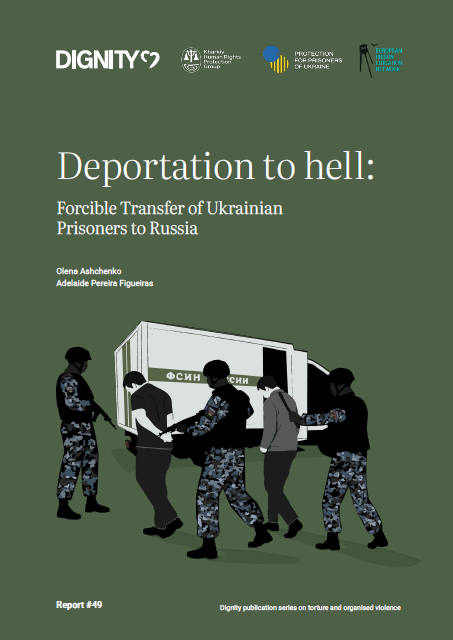
Read the full report
Deportation to Hell: Forcible Transfer of Ukrainian Prisoners to Russia was prepared by DIGNITY in cooperation with the Ukrainian civil society organisations Protection of Prisoners of Ukraine and the Kharkiv Human Rights Protection Group. It documents witness accounts, cross-references open-source evidence, and sets out the legal framework under the Rome Statute.
PREPARED BY
The report has been written by DIGNITY in collaboration with Protection of Prisoners of Ukraine and the Kharkiv Human Rights Protection Group and the European Prison Litigation Network, with support from the Ministry of Foreign Affairs of Denmark.




Contact
Bryggervangen 55
2100 Copenhagen Ø
Tlf: +45 33 76 06 00
[email protected]
CVR: 69735118
EAN: 5790000278114
Konto: 4183 4310821209
Organisation
Related links