»We will not wait for someone to
come and save us. We must create
the city we dream of ourselves«
Text: Salim Tayssir Melhem & Rahaf Odeh
In Zarqa, one of Jordan’s most violence-affected cities, young people, teachers and local organisations together with authorities are creating safer communities through dialogue, psychosocial support and a shared belief that change must start from within.
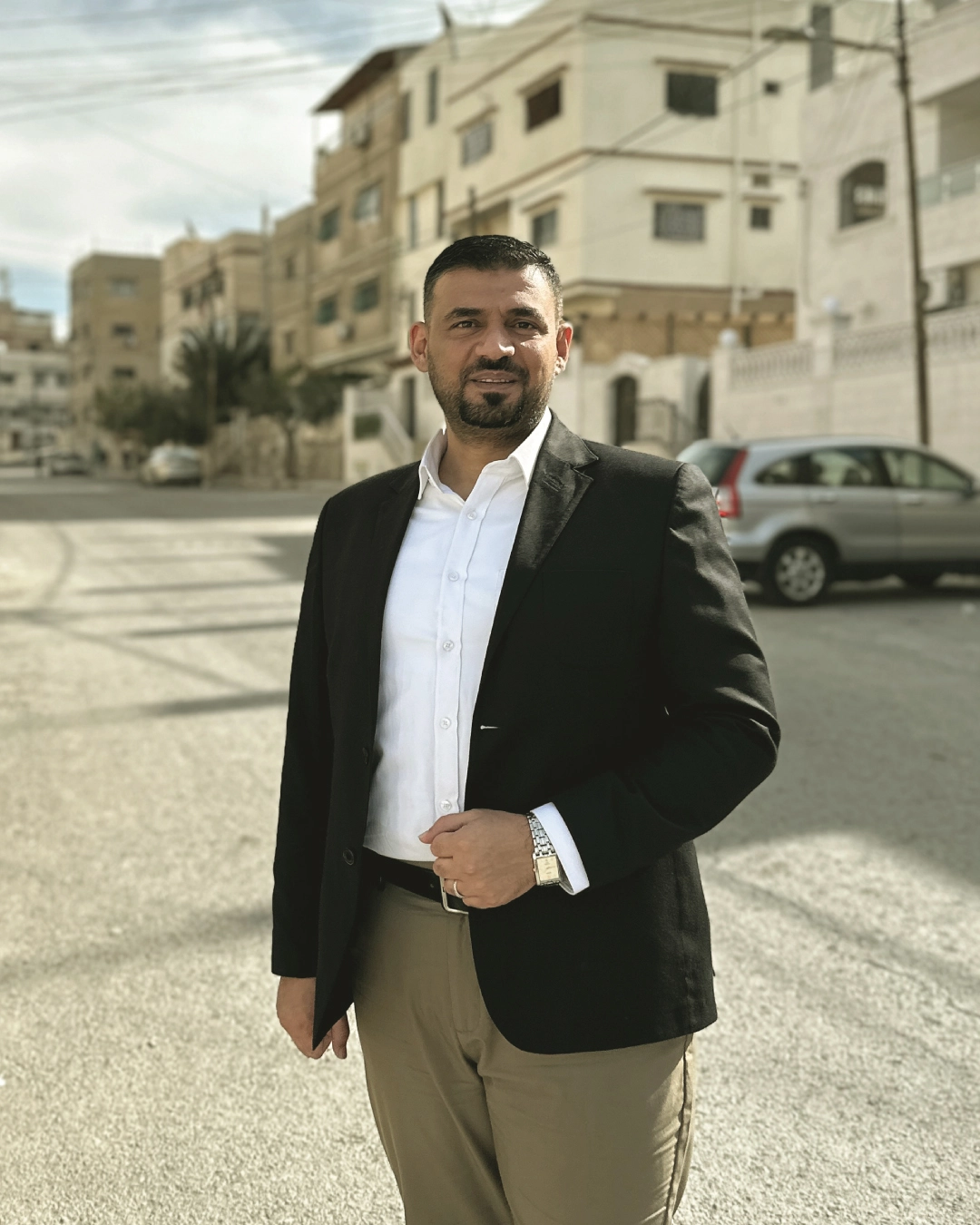
Prevention. Rafat Badran, Executive Director of the organisation NAYA
»If we who were born here don’t do anything, then who will?«
The question comes from Rafat Badran, Executive Director of NAYA, an organisation that works to prevent violence in the city of Zarqa. For years, Zarqa has been highlighted in Jordanian media as one of the country’s most socially vulnerable cities, marked by poverty, radicalisation, and unemployment. According to Jordan’s national statistics authority, Zarqa had a population of 1,675,700 in 2024.
It is also one of the places where everyday violence is most widespread and has been for many years. This applies not only to violence in the streets, but also in homes and schools.
A national study has previously shown that up to 81 per cent of all children have been exposed to physical or psychological violence used as a disciplinary method. Looking specifically at physical violence, 47 per cent of children aged 8 to 17 report having experienced it at the hands of their parents. At the same time, 44 per cent and 28 per cent report having experienced physical violence from teachers at school.
»We are the ones affected by the violence – it’s my family. It’s ourselves we are fighting for. My neighbours and friends in the city matter to me,« says Rafat Badran from NAYA, one of DIGNITY’s local partners. NAYA works to prevent violence in Zarqa by strengthening community dialogue and promoting peaceful conflict resolution.
We Want Something Different
Rafat Badran was born and raised in the city. He therefore knows both Zarqa’s reputation across the country and its potential.
He points out that violence and the insecurity that follows have long cast a shadow over the city, pushing especially young people to want to leave.
»In the media, the city is often reduced to its darkest stories. Children who were burned with cigarettes by their teachers. A father who killed his two children after an argument with his wife. It is also not unusual to meet young men with scars on their faces from razor blade attacks,« he says, emphasising that while he knows these stories well, they are not the whole story of Zarqa. Many people want to move the city in a different direction.
That is why Rafat Badran, who previously worked as a schoolteacher, helped establish the organisation NAYA.
»I have witnessed firsthand how violence destroys a community. When I started NAYA, I knew I couldn’t solve the problem alone. We have to do it together,« says Rafat Badran, who has himself been exposed to violence.
»I was on my way home when I was suddenly surrounded by 20 people and beaten in the middle of the street. I had no idea why. Only later did I find out it was due to a conflict they had with a member of my family.«
Clan-based violence is also described in DIGNITY and NAYA’s study on violence in Zarqa, where clan structures can contribute to escalating conflicts. A minor incident – for example, one child hitting another – can quickly develop into a violent confrontation between families.
Rafat Badran describes a diverse city where social and economic tensions also intersect: poverty, multiple nationalities, refugee populations from Syria and Palestine carrying trauma from war and displacement, and religiously diverse neighbourhoods of Christians and Muslims living side by side.
»All of this creates an environment where conflicts can easily escalate if there are no clear frameworks for how we can handle them,« he says, continuing:
»The most important thing is that we have shared rules of the game, where violence – both in the home and on the streets – has no place in our society. Even though it is illegal under Jordanian law, it still exists, and we must take that seriously. «
Supporting the Victims
DIGNITY and NAYA’s study on violence in Zarqa shows, among other things, that women and children often are considered the most vulnerable and most frequent victims of violence. Based on this evidence, NAYA’s interventions therefore primarily target women and children affected by violence in Zarqa. Psychological support – help in managing stress, difficult emotions, and trauma – as well as psychological first aid, play a central role, emphasises Rafat Badran.
Aya Najjar, MHPSS provider at NAYA, agrees.
NAYA’s staff have been trained in PM+ (Problem Management Plus), a structured programme developed by the World Health Organisation consisting of five sessions that help people manage everyday stress, conflicts, and trauma.
She points out that supporting victims is important not only because it improves their mental well-being, but also because it helps lower the overall level of conflict in vulnerable households and thus reduces domestic violence.
Among 526 surveyed residents in Zarqa, poverty was identified as the primary cause of violence both in the home and in society at large.
»Most of the problems we encounter are rooted in poverty. When finances are under pressure, communication within the family suffers, and small conflicts can escalate. We try to create a space where women can speak openly about the challenges they face every day,« says Aya Najjar.
Aya Najjar is from Zarqa and has lived there her entire life, and she also senses a positive change.
»Violence is never the victim’s fault. Those who commit violence should be reported to the police, and victims should receive help as soon as possible.«
»In the past, no one talked about mental health here. It was only about putting food on the table. Now, women are beginning to understand that their mental health also matters. If you are sad and hopeless, it affects your children too.«
She continues:
»Some of the women come to us completely silent and withdrawn. Seeing them raise their hands, engage, and develop trust in others means everything. Just showing up is a huge step.«
These small advances in women’s engagement and self-confidence show how change can begin at a very local level. At the same time, she points out that problems in the home can have consequences far beyond the family’s four walls:
»If one family has problems and another family has problems, their frustrations play out in society’. If no one gets help, the anger is channelled into the streets. That’s why everything starts in the home.«
Over the past six months, 100 women have participated in NAYA’s programmes, where they have received tools to manage conflicts at home and psychological first aid if they themselves have been exposed to violence.
For Aya Najjar, the work is not only about helping vulnerable women and children. It is also about strengthening the entire community and creating better and safer conditions for future generations.
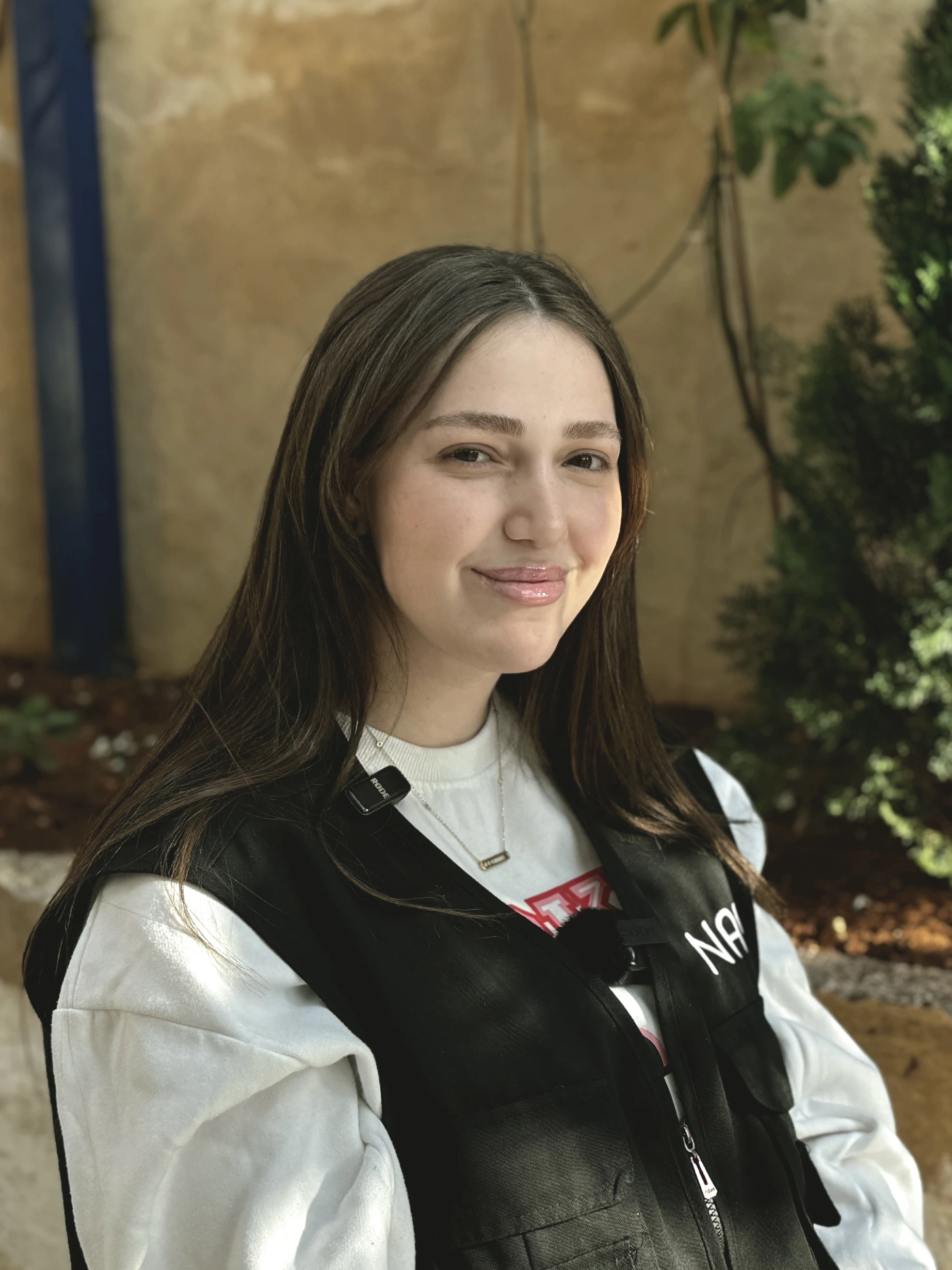
Support. Aya Najjar, MHPSS provider at NAYA
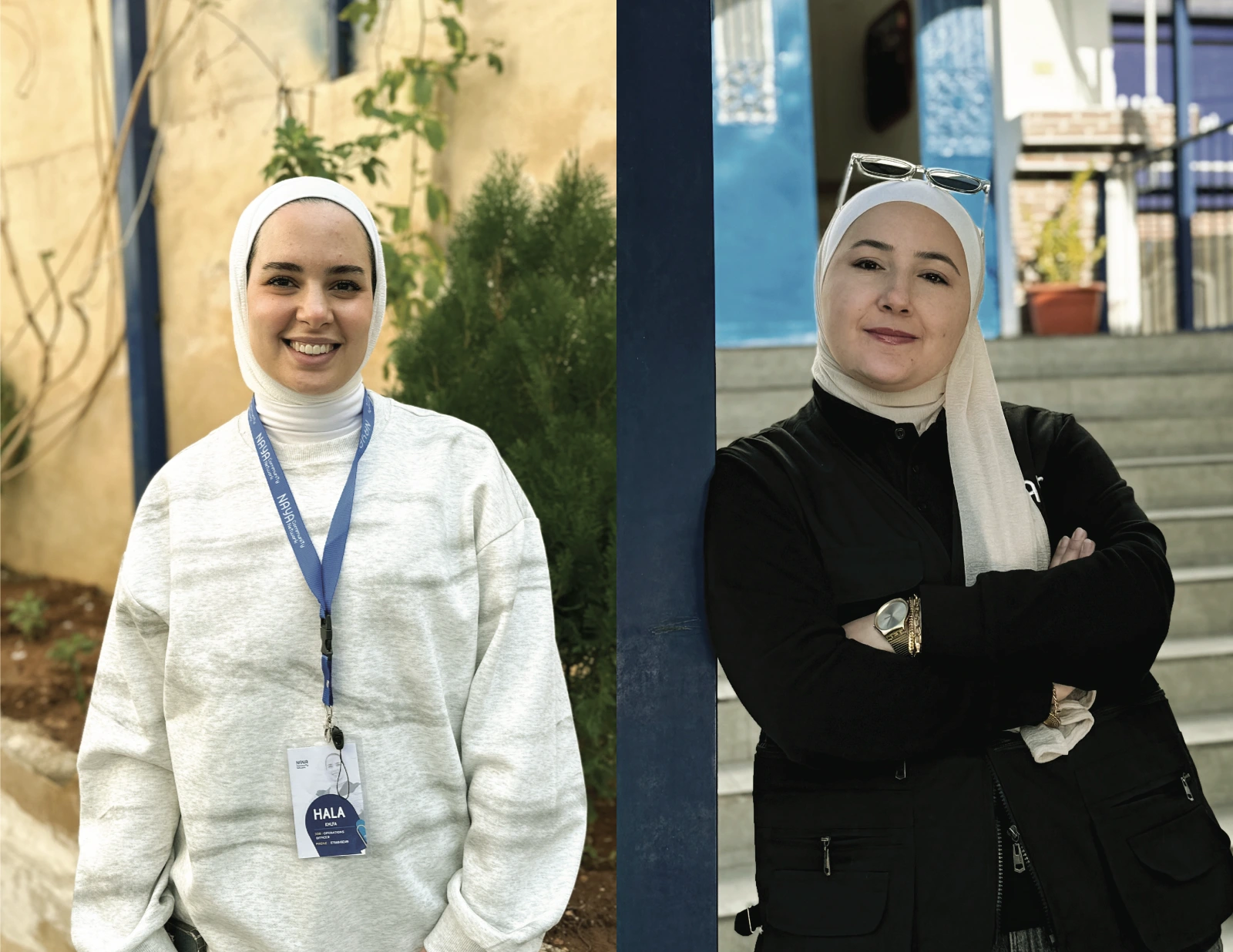
Hala Khalfa (left) and Ayat Shawish (right).
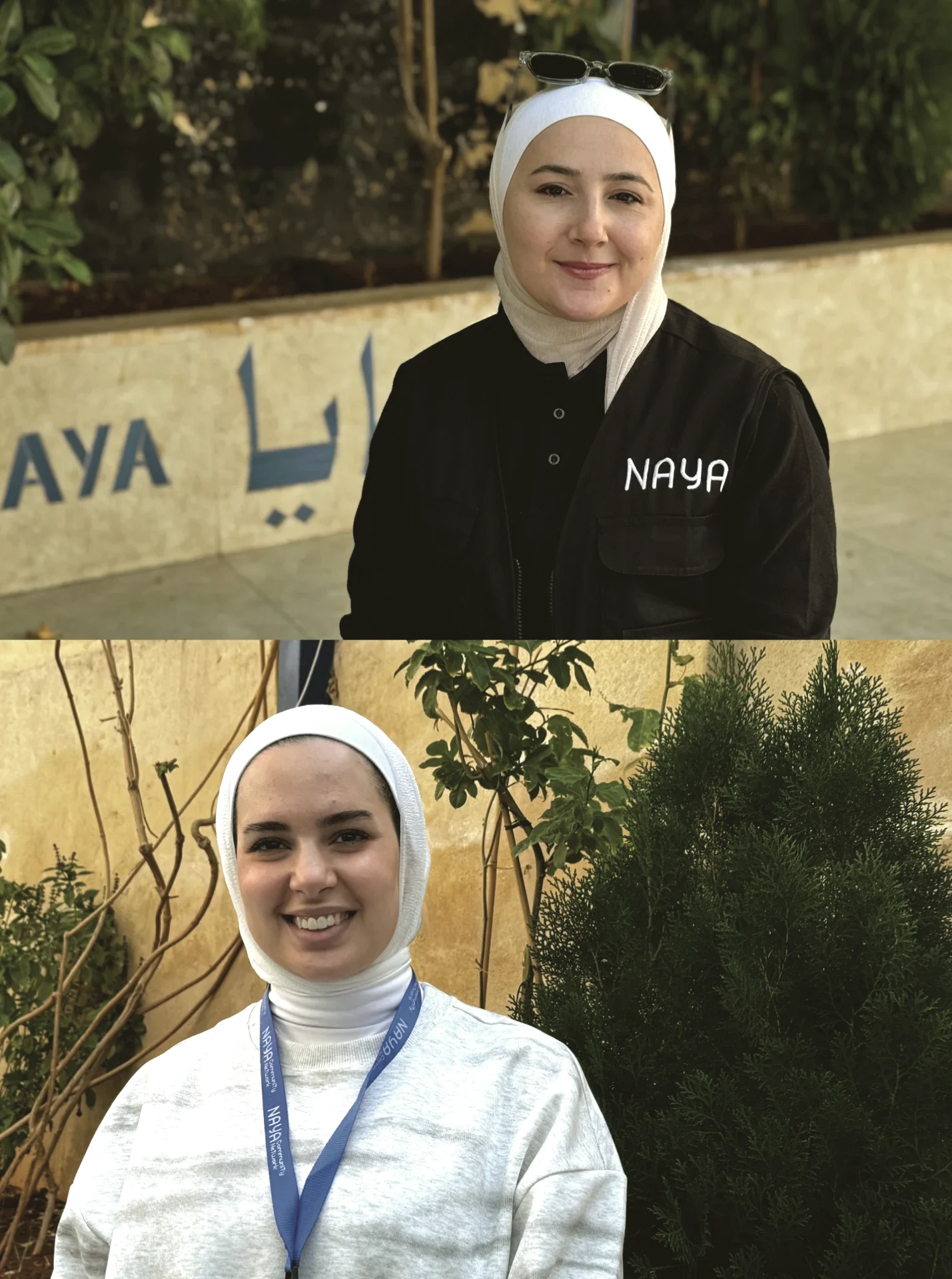
Ayat Shawish (top) and Hala Khalfa (bottom).
Her colleagues at NAYA, Ayat Shawish and Hala Khalfa, share this view.
»I have four children myself, and this is my neighbourhood. I want to make it a better place – for my children and for the next generations,«
The Project Manager, Hala Khalfa, adds:
»I am from Zarqa myself, and I feel a responsibility to make our city a better place. We work to break the cycle of violence so that children can grow up without violence, and our community can feel safe.«
»Children should grow up without violence«
One of the young people who has received support from NAYA is 21-year-old Laith. He grew up in a vulnerable home marked by conflict and later experienced how aggression became part of everyday life.
»I thought it was normal,« he says quietly.
Through NAYA, Laith has learned to cope with the psychological strain caused by exposure to violence:
»I used to go home and carry everything alone. NAYA gave me a language to talk about it. If I had tried to talk to my friends, they would just have said it was normal.«
He continues:
»Either I become like many from my parents’ generation, or I do something about it. My advice to others is: If you don’t want to be a victim of violence, then you must not use violence yourself. This is where we have to begin.«
Laith has received psychological first aid through NAYA, which has strengthened his self-confidence and given him tools to manage his anxiety.
»As a child, I was very shy. I would shake when speaking to strangers. The violence I experienced at home made me withdraw. Now I feel more confident.«
Zarqa means everything to him:
»It’s my family, my friends, my home. Everyone says you should move away. But why should I? I want to change the city for the better.«
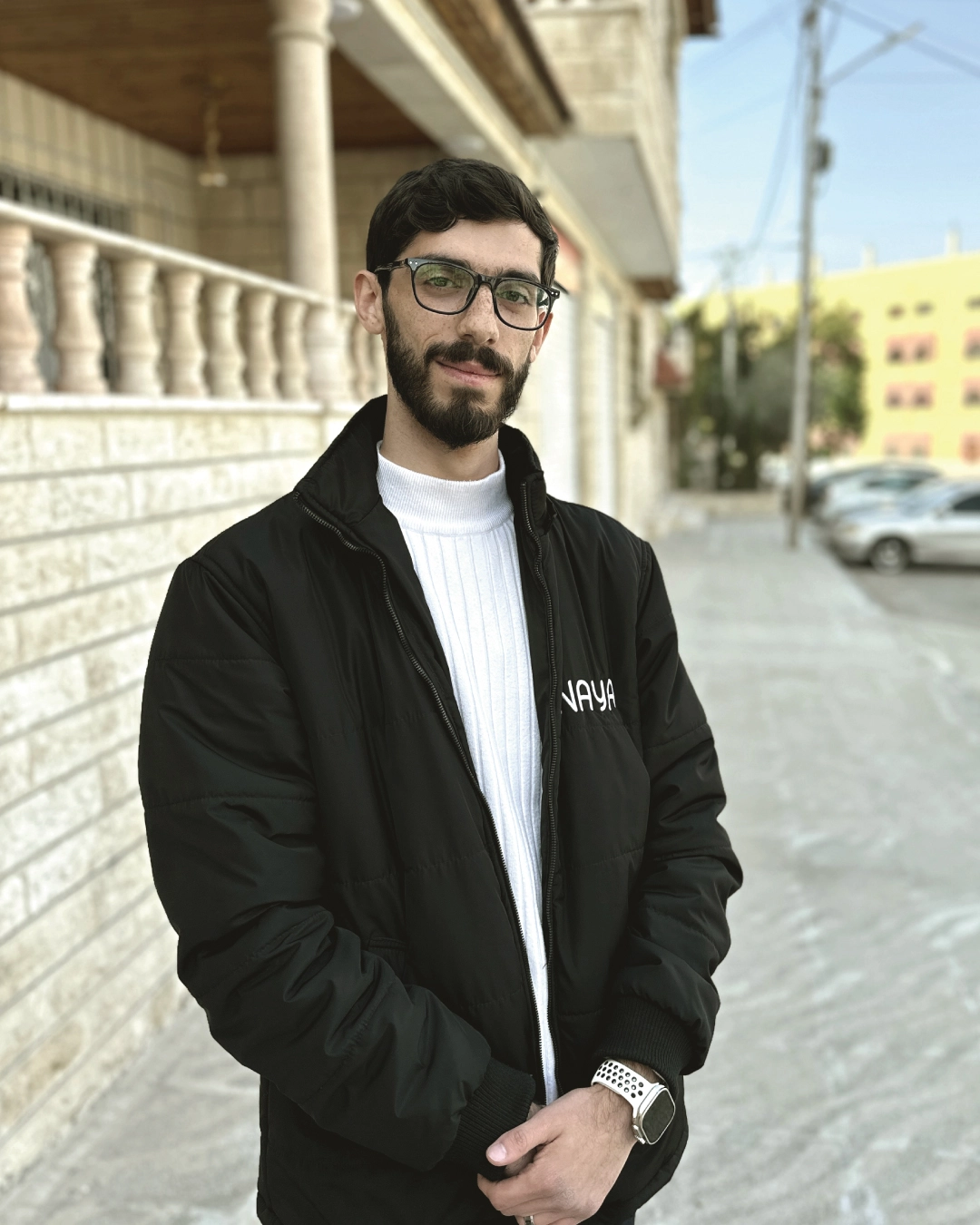
Support. One of the young people who has received support from NAYA, 21-year-old Laith.
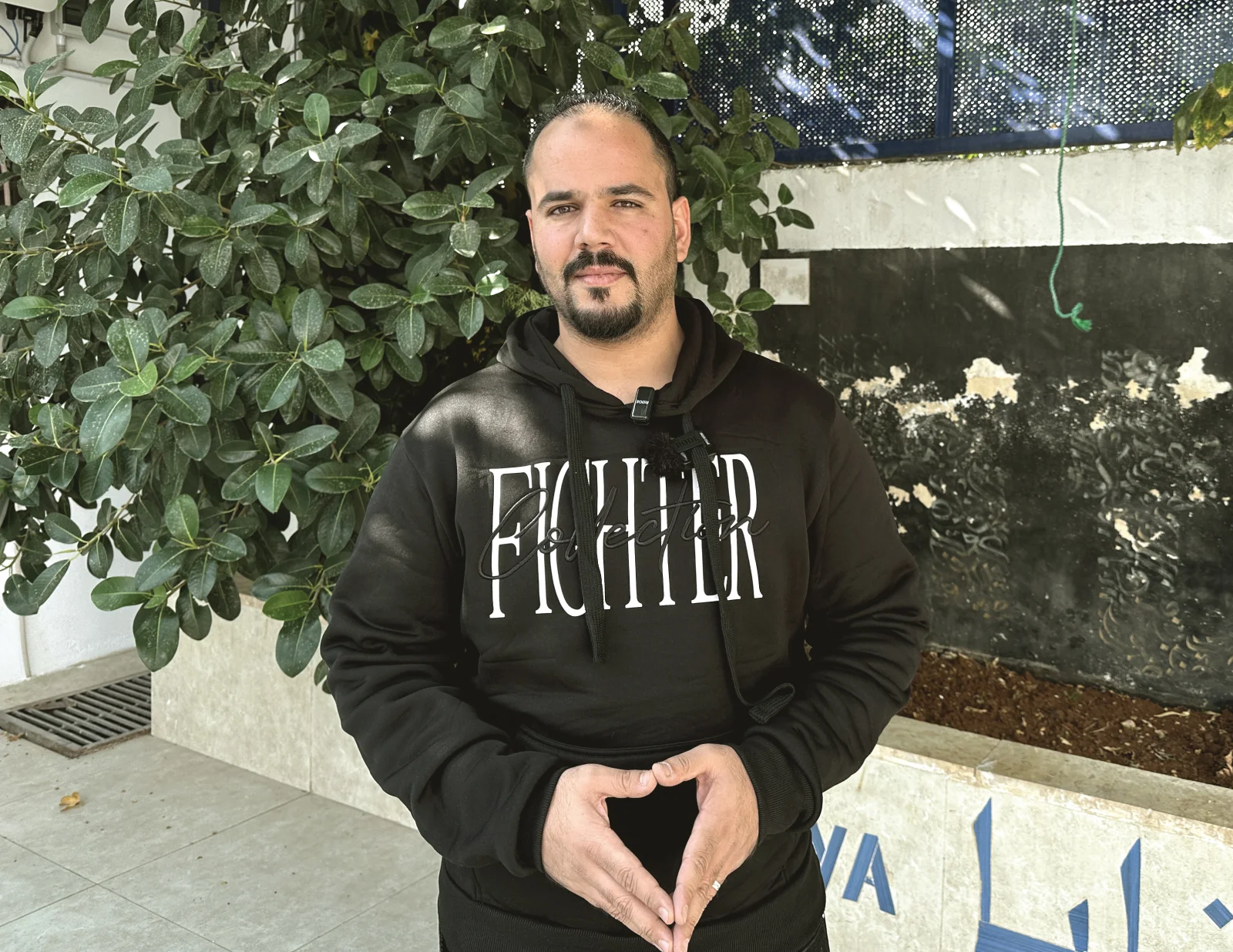
Training. One of the teachers who has received training from NAYA, Mahmoud Yaseen.
School as a Battleground – and as an opportunity
In Zarqa, studies show that the majority of violence experienced by children takes place in the home, but they also point to serious challenges in the city’s schools.
One of the teachers who has received NAYA training is Mahmoud Yaseen. He is a biology teacher at a local school in Zarqa with many years of experience in education, and he has seen the consequences up close.
»I have seen with my own eyes how violence affects children. It frustrates me that the area I live in is marked by so much insecurity, « he says.
This is why he initiated the project »We Are With You« together with NAYA, combining psychosocial support with education on gender-based violence for students aged 12 to 15 – an age where conflicts and violence often take shape, but where attitudes can still be influenced, according to Mahmoud Yaseen.
While teacher Mahmoud Yaseen promotes non-violence and positive behaviour at the local level, school violence is mainly addressed through national programmes run by the Ministry of Education in cooperation with organisations such as UNICEF. Initiatives aim to monitor violence, create safer school environments and strengthen staff capacity for students aged 13 to 16.
Mahmoud Yaseen also works closely with other teachers to provide them with concrete tools to manage conflicts and students who display violent behaviour.
He describes a boy who reacted aggressively after his parents’ divorce. Through care, structure, and targeted tasks at school, Mahmoud Yaseen sought to support the boy.
»The most important thing is that teachers become aware of how they can engage students and reduce violence in the classroom. Authority does not come through violence, but through knowledge and understanding,« he says.
Despite the major challenges, Mahmoud Yaseen experiences that more students are showing greater respect for one another, and that teachers have become better at handling problems.
»I dream that we get more materials on violence prevention and that teachers use them. It will make the school safer in the classroom and on the way to and from school. It also raises the quality of education,« he says.
For Mahmoud Yaseen, the work is not only about the school. It is about creating a future where children can grow up without violence.
»If we continue on this path, we can truly make a difference for the next generations.«
At the same time, several local actors in Zarqa emphasize that initiatives like this represent only one piece of a larger puzzle.
Sustainable violence prevention requires long-term social investments that create employment, include civil society, and improve structural living conditions in the area.
Sustainable violence prevention requires long-term social investments that create employment, engage civil society and improve structural living conditions in the area.
Director General Rafat Badran agrees. For him, the ambition behind NAYA’s work is very clear:
»I hope there will never be a queue at NAYA. I dream of a day when my organisation no longer exists. Because then I will know that we have achieved our goal — that violence in Zarqa has been reduced.«
The Danish-Arab Partnership Programme and the collaboration with NAYA
Since 2023, DIGNITY has collaborated with the Jordanian organisation NAYA Foundation in Zarqa to prevent violence and strengthen psychosocial support for people exposed to violence and serious violations.
The collaboration focuses on developing and strengthening local initiatives to prevent violence and provide psychosocial support to people living with the consequences of violence in their families and communities. Through joint activities, the partners develop and test methods to support individuals living with severe stress, trauma, and other consequences of violence.
The project is part of the Danish-Arab Partnership Programme (DAPP), Denmark’s cooperation programme with civil society organisations in the Middle East and North Africa. The programme aims to promote human rights, inclusion, and civil society’s ability to drive positive societal change.
Jordan is one of the programme’s focus countries, alongside Morocco, Tunisia, and Egypt.
DIGNITY's work is supported by the
Danish Ministry of Foreign Affairs.
DIGNITY's work is supported by the Danish Ministry of Foreign Affairs



Contact
Bryggervangen 55
2100 Copenhagen Ø
Tlf: +45 33 76 06 00
[email protected]
CVR: 69735118
EAN: 5790000278114
Konto: 4183 4310821209
Organisation
Related links
