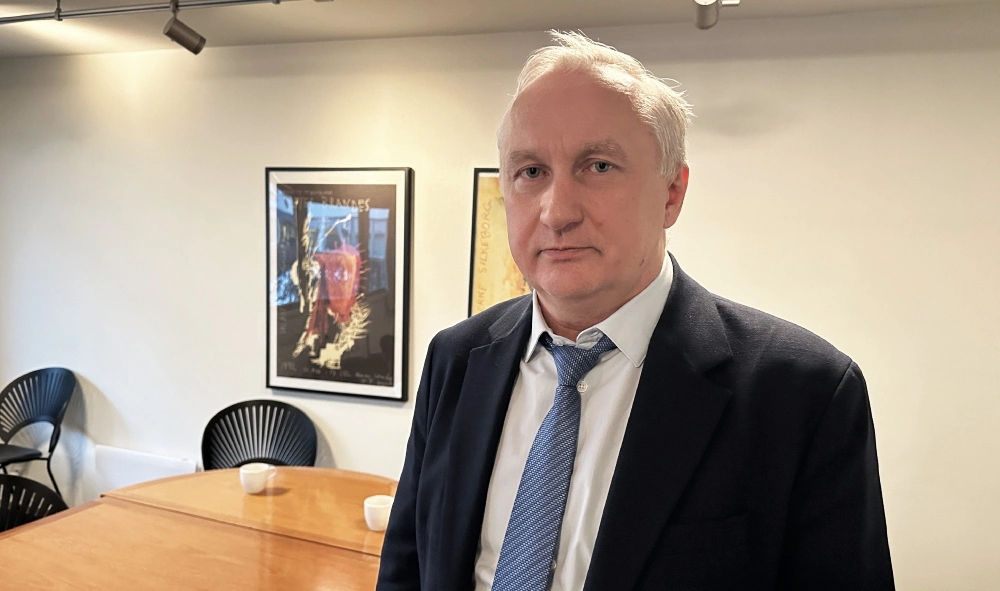
By Pavel Sapelka, Member of the Interim Board, Human Rights Center Viasna
What is the most challenging aspects of your work at the moment?
For several years now, we have been living and working in exile, continuing our activities from multiple countries for Belarus and for Belarusians. Today, the most difficult aspect of human rights work is the combination of a totally repressive environment inside the country and the need to maintain systematic, professional work under conditions of exile and constant pressure.
We are not dealing with isolated human rights violations. What exists in Belarus is a sustained system in which the police, the law, the courts, and the prison system are deliberately used as instruments of political repression. For human rights defenders, this results in severely limited access to information, serious risks for people inside the country who interact with us, and the criminalization of human rights work itself.
An additional challenge is the emotional burden. We work closely with cases involving people who have spent years in detention, who have been subjected to torture and ill-treatment, prolonged isolation, and deprivation of contact with their families. This has a profound impact, both on survivors and on those documenting and supporting their cases.
How are you addressing these challenges in practice?
In practice, we organize our work on several levels. First, we apply strict standards of documentation and verification to ensure the credibility and reliability of our data, even under conditions of limited access.
Second, we rely on distributed teamwork, with constant attention to security. This applies both to our staff in exile and to people inside Belarus who provide information at great personal risk.
Third, we actively engage with international mechanisms – including the UN, the OSCE, EU institutions, and national governments. A key part of our work is translating concrete human stories into the language of international law and state responsibility.
Finally, mutual support within the team and close cooperation with other human rights organizations are essential. Without solidarity, trust, and collective effort, this work would not be possible.
What has made a tangible difference over the past year?
Over the past year, increased international attention to the situation of Belarusian political prisoners has made a tangible difference. This has been particularly important in the broader context of growing awareness of transnational repression.
We are working consistently to ensure that the human rights situation in Belarus is not treated as an “internal matter,” but recognized as a universal issue and a matter of regional and international security.
There has also been a noticeable increase in interest in the legal qualification of repression. Issues such as arbitrary deprivation of liberty, de facto statelessness, and cross-border persecution are being examined more closely, which strengthens the legal foundation of our work.
What gives you hope for 2026 in your work, and why?
Hope comes from the continued development and adaptation of international mechanisms to new forms of repression. Accumulated documentation, legal analysis, and collective efforts do not disappear without a trace.
My hope for 2026 is not based on expectations of quick solutions. It is grounded in the understanding that the truth documented and preserved today will form the basis for justice in the future – for the release of people, the restoration of their rights, and accountability for those who designed and carried out repressive policies. Accountability must become the norm.
At the end of 2025, our colleagues Ales Bialiatski and Uladzimir Labkovich were released from prison. Our central hope for 2026 is to see our colleagues Valyantsin Stefanovich and Maryia Rabkova – along with more than a thousand other imprisoned human rights defenders and activists from Belarus – regain their freedom.